
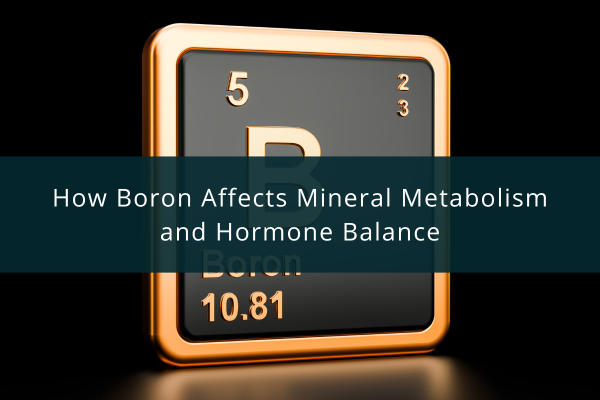
In our bodies’ complex symphony of nutrients and signals, one trace mineral often flies under the radar — Boron. Yet there’s growing evidence suggesting boron plays a crucial role in how minerals, hormones and even brain function operate.
In this article, we’ll explore:
- What boron does in the body
- Why it may be becoming depleted in modern life
- The possible consequences of low boron status
- Practical steps to rethink our environment and nutrition
How Boron Supports Key Functions in the Body
Research shows that boron interacts with mineral metabolism — especially calcium, magnesium, phosphorus and vitamin D — and influences hormones such as estrogen and testosterone. For example:
- One review states: “Numerous studies suggest that boron interacts with other nutrients and plays a regulatory role in the metabolism of minerals … increasing the concentration of steroid hormones such as testosterone and ß-oestradiol.” (PubMed)
- Another review: “Boron deprivation results in decreased brain electrical activity … and poorer performance on tasks of motor speed and dexterity, attention, and short-term memory.” (PubMed)
- Further work claims boron “(1) is essential for growth and maintenance of bone; (2) greatly improves wound healing; (3) beneficially impacts the body’s use of estrogen, testosterone, and vitamin D; (4) boosts magnesium absorption …” (PubMed)
Bottom line: While science has not yet deemed boron formally “essential” for humans, the evidence suggests it plays many subtle but meaningful roles. (Office of Dietary Supplements)
Why Boron Deficiency May Be More Common Today
A range of modern stressors—from soil depletion to hormone-disrupting exposures—may affect the body’s natural boron levels.
- Electronic devices, Wi-Fi, ionization of atmosphere & soil: The theory is that increased ionization and electromagnetic exposures may disrupt mineral balances including boron.
- Soil and produce depletion: Modern intensive agriculture may lower trace-mineral concentrations in the soil (and hence in plants) over time, reducing dietary boron.
- High exposure to estrogenic or hormone-disrupting agents: Since boron appears tied to hormone regulation (especially estrogen/testosterone), environments that increase estrogen or lower testosterone could “unbalance” the system in which boron plays a part.
While parts of this theory remain speculative (especially the “electronics/ionization” side), the idea is worth exploring — especially as behavioral and cultural changes magnify the stress.
How Boron Deficiency May Impact Health
Although research is still developing, low boron status has been linked to shifts in mineral metabolism, hormonal balance, and cognitive performance.
- Mineral misregulation: Without sufficient boron, the coordination of calcium, magnesium, phosphorus and vitamin D may falter, compromising bone and tissue health.
- Hormonal shifts: Because boron influences estrogen/testosterone balance, low boron may be associated with higher estrogen, lower testosterone, or disrupted hormonal status.
- Cognitive / brain-function effects: Some studies show poorer outcomes in attention, short-term memory and psychomotor speed when boron status is low. (PubMed)
- “Slow decay” scenario: If you imagine the body as a building, lacking repair and regulatory coordination (in which boron plays a part) means the structure slowly loses integrity.
- Socio-behavioral concerns: As a cultural aside — there’s a suggestion that in societies where “passivity” increases (for example heavy gaming, chronic device-use, high-estrogen-lifestyle choices, disengagement) the domino effect of hormonal imbalance + mineral misregulation may play into lesser ambition, dependence or reduced male-profile vitality (though this is speculative and socially charged language should be handled carefully).
Boron Research: Benefits, Limits, and Unknowns
The scientific picture around boron is still emerging, with intriguing findings but important limitations to keep in mind.
- According to the National Institutes of Health, “Scientists aren’t certain what role, if any, boron has in the body, so they don’t consider boron to be an essential nutrient.” (Office of Dietary Supplements)
- Food-sourced boron: Most adult Americans consume about 1 mg/day from food (e.g., fruits/vegetables/legumes) and no RDA (Recommended Dietary Allowance) has been set. (Office of Dietary Supplements)
- Some studies show benefits (bone mineral density, hormone levels), but many are small, short-term or animal-based; findings for large human trials remain limited. (PubMed)
- On the flip side, taking very high doses of boron is not risk-free: excess intake has been linked to adverse effects (especially in sensitive groups). (Office of Dietary Supplements)
In short: there’s intrigue and plausible mechanism, but we should avoid overstating certainty.
How to Naturally Support Boron Levels and Hormone Health
If you’re looking to naturally support boron levels and overall mineral–hormone balance, here are practical steps to consider.
- Diet first: Focus on plant-based foods rich in boron: dried fruits (raisins, prunes), nuts, legumes, leafy greens, non-citrus fruits. (Verywell Health)
- Soil & foods matter: Choose produce from rich soils (if possible), rotate crops, support regenerative agriculture — while concrete metrics for boron in soil are rare, the broader trace-mineral story is valid.
- Minimize patterns that may increase hormonal/mineral stress: Consider moderating chronic high-estrogen exposures (environmental estrogens, certain processed foods), over-use of technology (sedentary screen time), heavy device/ionization exposures (while data is limited, reducing excessive exposure may help).
- Balance hormones & lifestyle: Maintain healthy physical activity, sleep, stress management, which all play into hormone regulation and mineral metabolism.
- Supplement: Always consult a licensed healthcare provider before supplementing.
Understanding Boron’s Role in Today’s Environment and Your Health
Modern life brings unprecedented exposures: electronics, processed foods, hormone-disrupting chemicals, changes in soil and agriculture, and sedentary culture. These shifts may stress our bodies’ internal regulation systems — including mineral-hormone coordination, where boron may play a role.
While boron isn’t a silver bullet, acknowledging and supporting trace-mineral balance, hormone regulation and meaningful lifestyle choices gives us tools — rather than blaming culture or technology solely. If you take a balanced approach (diet, movement, environment, lifestyle), you give your system a better chance to maintain harmony.
Fun Fact: The Boron Test (Peach Edition!)
Did you know you can spot low boron levels in fruit just by looking at how the pit behaves?
If the core or seed separates easily from the flesh — that’s actually a sign the fruit is low in boron!
Boron helps strengthen cell walls in plants (and bones in us!), so when it’s lacking, the fruit literally starts to “fall apart” from the inside out.
References at a glance:
- Kelly GS. Boron: A Review of its Nutritional Interactions and Therapeutic Uses. Alt Med Rev. 1997. (Alternative Medicine Review)
- Khaliq H, Juming Z, Ke-Mei P. The Physiological Role of Boron on Health. Biological Trace Element Research. 2018. (refp.cohlife.org)
- Krans B. Brains, Bones, and Boron. Healthline. 2019. (healthline.com)
- NIH Office of Dietary Supplements. Boron Fact Sheet for Consumers. (Office of Dietary Supplements)
Beddoe, A. F. Biological Ionization as Applied to Human Nutrition. (Advanced Ideals Institute, 1997)