

A patient came to me several years ago with a history of chronic urinary tract infections (UTIs). Her case was a bit unusual because, theoretically, she should not have UTIs at all. The patient had Crohn’s Disease and had a total colectomy performed a year earlier. This meant that she had no colon at all and her rectum had been removed.
The Connection Between Gut Health and Systemic Inflammation
In women, the thought process behind recurrent UTIs is that bacteria migrate from the rectum forward into the genito-urinary tract and eventually finds its way into the bladder. So, without a rectum, how was this patient having recurrent UTIs? In this particular patient, there was concern because of the underlying Crohn’s Disease that she might have had an underlying fistula between the ileum and the bladder. A CT scan of the abdomen with oral contrast did not reveal any such fistula.
Another avenue for UTIs is intestinal permeability, or leaky gut. Dysbiosis and inflammation in the gut reduce the integrity of the intestinal wall and allow pathogens such as E. coli to migrate from the intestines to the bladder. Recently, I have written about how the GLP-1 semiglutide can cause UTIs in patients because of constipation. In my patient, the only organism that ever grew in the urine was Klebsiella oxytoca, a bacterium found in the human GI tract.
How a Grain-Free Diet Approach Can Help
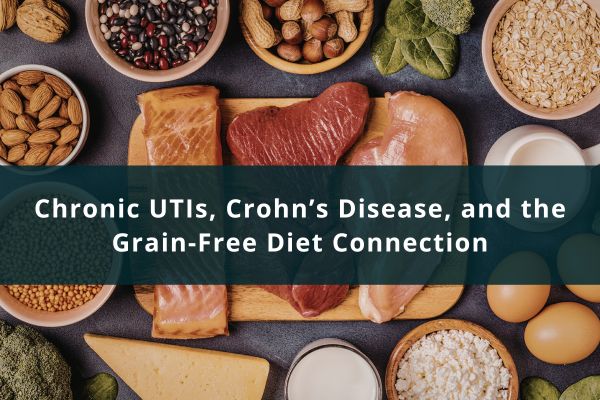
The patient was able to stay symptom-free, but only with suppressive therapy. However, the patient was not keen on long-term antibiotics. It was suggested to try a grain-free diet. The patient has been on a grain-free diet for nearly a year now, and she was happy to report that she has been symptom-free for the past six months with no antibiotics in that time frame.
Reduced Inflammation
So why did the grain-free diet work in this patient? The answer; grain free diets reduce inflammation in the body. By reducing inflammation, intestinal permeability is reduced, along with the likelihood of bacterial migration into the bladder. It also helps in reducing joint pain, especially in relation to autoimmune diseases. Many patients with autoimmune disease find a significant decrease in symptoms with a grain-free diet.
Stabilized Blood Sugar
A secondary benefit of the grain-free diet is stabilizing blood sugars. With better glucose control, patients who suffer from chronic inflammatory states find their symptoms much more manageable with less sugar in their diets. When it comes to sugar and inflammation, sugar is like throwing jet fuel on a fire.
A Note on “Gluten-Free” Substitutes
This brings me to another point. Beware of gluten-free products such as gluten-free bread and pasta. In many instances, the flour that is used in those products is either potato flour or rice flour. The glycemic index of these types of flour is much higher than the glycemic index of wheat flour, so there will be much more sugar in the diet defeating the overall objective. Stick with whole foods, especially whole fruits and vegetables. It will make a huge difference.
Reducing Inflammation Through Dietary Manipulation in Chronic Diseases
Recently, I had another patient with Crohn’s Disease come to the practice. Despite maximum therapies with immunosuppressive agents, she was still extremely symptomatic. Since being on a grain-free diet, her symptoms have improved significantly. The initial patient wonders if her total colectomy would have been necessary if she had been on a grain-free diet years before. It’s hard to say. Regardless, when it comes to chronic infections, reducing inflammation through dietary manipulation is an important adjunct in managing patients.
I have been recommending this to all my patients with chronic UTIs and chronic prostatitis to try and minimize their sugar intake. It appears to help significantly.